After the Scan: How Referral Pathways Work in the Field
A field-based analysis of health screening referral pathways, from community screening and triage to clinic arrival, follow-up, and real-world completion gaps.
After the Scan: How Referral Pathways Work in the Field
Health screening referral pathways field work is where a lot of programs quietly succeed or fail. A screening day can identify risk, generate numbers, and look impressive in a report. But the real test comes after the scan. Does the patient understand what happened? Does the community health worker know what to do next? Does the referral reach a facility that can actually receive the person, confirm the finding, and keep the case moving? In field settings, that handoff matters as much as the screening itself.
"Overall, 121 (89%) caregivers reported taking the referred child for further medical evaluation." — Jana Jarolimova and colleagues, Malaria Journal (2018)
Health screening referral pathways field teams actually depend on
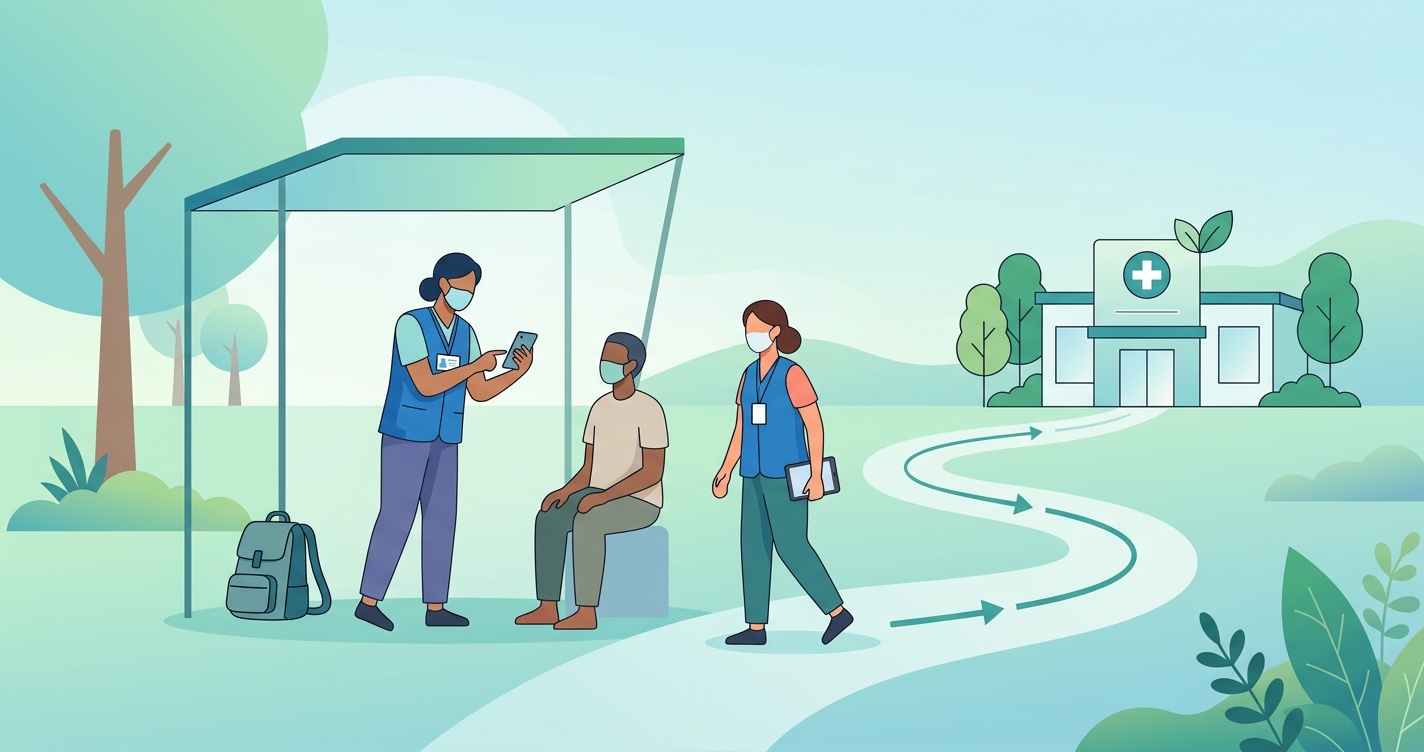
A referral pathway sounds tidy on paper. In practice, it is a chain of small decisions made under pressure. A village health worker screens someone in a home, school, market, or outreach site. The worker explains the result, writes or sends a referral, and asks the person or caregiver to continue to the next level of care. After that, the pathway depends on transport, cost, trust, family priorities, clinic hours, staffing, and whether the receiving facility takes the case seriously.
That is why referral pathways should be treated as operational systems, not as admin paperwork. The field evidence keeps coming back to the same point: screening can be decentralized much faster than follow-up care can.
In rural western Uganda, Jana Jarolimova, Stephen Baguma, Palka Patel, and colleagues tracked referrals initiated by community health workers in an integrated community case management program. Their 2018 Malaria Journal study found that 89% of caregivers said they sought further evaluation, and 75% overall went to the local public health center. Those are strong completion numbers. They suggest that referral pathways can work well when the illness is acute, the next facility is locally known, and the worker's recommendation carries social weight.
The picture looks different in chronic disease screening. In eastern Uganda, Andrew Marvin Kanyike, Raymond Bernard Kihumuro, Timothy Mwanje Kintu, and colleagues published a 2025 quasi-experimental study in the Journal of Health, Population and Nutrition on community-based hypertension screening by Village Health Teams. The VHTs screened 5,215 adults, and 22.4% had elevated blood pressure. But only 23.8% accepted referral, and only 24.8% of those who accepted actually reached the facility. What stands out to me is not that community screening failed. It clearly did not. The screening found a large number of high-risk adults. The weak point was the handoff after detection.
What changes once the scan becomes a referral
| Referral stage | What happens on paper | What often happens in the field | What it means for programs |
|---|---|---|---|
| Screening and triage | Worker identifies risk and recommends follow-up | Patients may feel well and not view the referral as urgent | Asymptomatic conditions have lower follow-through |
| Explanation of result | Worker explains why referral matters | Explanation may be brief, rushed, or hard to translate into local risk language | Understanding shapes completion |
| Transport to facility | Patient goes to the designated clinic | Distance, fees, rain, work, childcare, or stockouts get in the way | Referral attrition starts fast |
| Reception at facility | Clinic confirms and records the referral | Registers may be inconsistent and queues may be long | Poor reception weakens trust in future screening |
| Follow-up and continuity | Patient enters care pathway | No call-back, no return date, or no treatment plan | Screening looks successful while care remains incomplete |
Why referral completion is high in some programs and low in others
The easiest mistake is to talk about "referrals" as if they were one thing. They are not. The field logic changes depending on whether the program is responding to fever in a child, screening blood pressure in an adult who feels fine, following up a pregnant mother, or identifying a possible cancer case.
Acute child illness often produces higher urgency. Jarolimova's Uganda study fits that pattern. Caregivers of sick children had a visible reason to continue care, so the community health worker's referral translated into action more often.
Chronic disease is harder. Hypertension screening produces many positive findings, but a raised blood pressure reading does not always feel like a crisis to the person being referred. That helps explain the Kanyike study's steep drop from screening to facility arrival. The problem was not detection. It was the gap between identifying risk and persuading someone to spend time and money on a next step that may not feel immediately necessary.
A third pattern appears in maternal and newborn care. Gertrude Namazzi, Monica Okuga, Moses Tetui, and colleagues reported in Global Health Action in 2017 that community health workers in eastern Uganda improved maternal and newborn knowledge after training, and the coverage of at least one CHW visit to pregnant or newly delivered mothers reached 57.3%. They also found low dropout among workers, at 3.6%, but flagged transport and motivation as persistent issues. That matters because referral pathways depend on the worker still being able to revisit homes, reinforce advice, and keep families engaged after the first contact.
- Referral pathways work better when the health concern feels urgent to the patient.
- They work better when the next facility is nearby, familiar, and prepared to receive referrals.
- They weaken when screening finds risk but does not create a believable reason for follow-up.
- They weaken even more when the worker has no practical way to check whether the referral was completed.
Industry applications in community and field programs
Child health screening and case management
Integrated community case management programs often show the cleanest referral logic because symptoms are visible and timelines are short. A child with fever, breathing difficulty, or worsening diarrhea creates a problem a caregiver recognizes right away. In those settings, referral tools do not need to persuade people that something might happen later. They need to shorten the trip from concern to treatment.
Noncommunicable disease screening
Adult screening pathways are much more fragile. Blood pressure, diabetes risk, and similar conditions tend to generate lower urgency and more drop-off. That is where messaging, repeat contact, and structured follow-up matter. Screening volume alone can make a program look productive while the underlying referral pathway remains thin.
Maternal and newborn pathways
In maternal and newborn care, the referral pathway often depends on repeated household contact rather than a single event. Programs with strong community worker networks can reinforce birth preparedness, danger-sign recognition, and return visits. The point is not just to issue referrals. It is to keep the family moving through the pathway.
Current research and evidence
One useful baseline still comes from the WHO guideline on health policy and system support to optimize community health worker programmes. WHO's 2018 guidance treats community health workers as part of the broader health system, not a substitute for it. That sounds obvious, but it has operational consequences. A community screening program cannot promise continuity of care if supervision, transport, supply chains, and receiving facilities are weak.
The Uganda studies make that point in concrete terms.
In the 2018 Malaria Journal paper, Jarolimova and colleagues showed that CHW-initiated referrals can achieve strong completion when the pathway is socially legible and geographically close. If 89% of caregivers say they sought further evaluation, the lesson is not that referrals are easy. It is that they become easier when urgency, worker credibility, and local facility familiarity line up.
In the 2025 hypertension study, Kanyike and colleagues showed the opposite side of the picture. Community screening uncovered a substantial burden of elevated blood pressure, but the cascade narrowed quickly after referral. Only a minority accepted referral, fewer reached the facility, and yet 94.3% of those who arrived were confirmed to be hypertensive. That last number is striking. It means the front-end screening was finding real cases. The bottleneck sat between detection and attendance.
A more qualitative view comes from Joseph Okello Mugisha and Janet Seeley, whose 2020 study in AAS Open Research explored training Village Health Teams to use a smartphone-guided intervention linking older adults with hypertension and diabetes to care. They found that all participating VHTs were willing to join the intervention, and by the end of training all but three could identify diabetes symptoms and measure blood sugar and blood pressure. What I take from that study is simple: field referral pathways are not only patient problems. They are capability problems too. If the frontline worker is well trained, the handoff gets sharper.
There is also an older but still useful implementation lesson in the 2016 Malaria Journal paper by Sham Lal, Richard Ndyomugenyi, Lucy Paintain, and colleagues on CHW adherence to referral guidelines in Uganda. The study focused on whether workers referred sick children according to training guidance. That may sound narrower than referral completion, but it gets at a foundational issue. A referral pathway cannot work if the pathway is not activated correctly in the first place.
The field design choices that usually matter most
Programs tend to obsess over the screening device, then underestimate the ordinary parts of referral design.
Here are the pieces that seem to matter most in practice:
- a clear explanation of why the person is being referred now
- a facility destination that is realistic for the household
- a way to confirm whether the patient arrived
- repeat contact when the condition is chronic rather than acute
- supervision that helps workers improve their judgment over time
I keep coming back to that last point. Referral pathways are built by people, not forms. A strong worker can improvise around transport delays, explain risk in familiar language, and persuade a family to keep going. A weakly supported worker cannot.
For microsites like TryCareView that focus on deployment reality, this is where contactless and smartphone-based screening fits the larger story. The technology can make first-contact assessment lighter and more portable, but it does not erase the referral problem. It simply makes that downstream problem more visible. Readers who want a broader view of how community and field screening programs are evolving can follow the Circadify research blog.
For related reading on this microsite, see How Health Screening Programs Build Trust in Communities and What Community Health Workers Think About Digital Tools.
The Future of Referral Pathways in the Field
The next improvement in field screening will probably not come from detecting more people. Many programs can already do that. The bigger shift will come from building better middle steps between detection and treatment.
That means more closed-loop referrals, better local follow-up data, and more realistic pathway design for conditions that do not feel urgent to patients. It also means treating referral completion as a core outcome rather than a side metric. A screening program that finds hundreds of possible cases but loses most of them after first contact is telling you something important about the health system around it.
I suspect the strongest field programs over the next few years will be the ones that make referrals feel less like a handoff into bureaucracy and more like a continuation of care.
Frequently Asked Questions
What is a referral pathway in field health screening?
A referral pathway is the process that begins after a person is screened and identified for follow-up care. It usually includes explanation of the result, transfer to a clinic or higher-level provider, confirmation at the facility, and some form of ongoing follow-up.
Why do referral pathways break after community screening?
They usually break because of distance, transport cost, weak explanation of the result, low patient urgency, poor facility reception, or lack of follow-up after the initial referral.
Are referral completion rates usually high in field programs?
It depends on the condition. Acute child illness referrals may achieve high completion, as seen in Jana Jarolimova's 2018 Uganda study. Chronic disease referrals often drop off more sharply because the patient may not feel sick even when screening identifies risk.
What makes a field referral pathway stronger?
Clear worker training, realistic facility destinations, repeat contact, and a way to confirm whether the patient actually arrived all make the pathway stronger.
Does better screening technology solve the referral problem?
No. Better screening can improve first contact, but referral completion still depends on trust, transport, clinic readiness, and ongoing follow-up.